

How Much Should a Small Business Spend on SEO?
If you run a small business, you may already know that SEO can help you attract more customers through Google. But one question usually comes before hiring an SEO specialist:
How much should a small business actually spend on SEO?
There isn’t one price that works for every business. SEO costs can vary significantly depending on your industry, competition, website size, target location, and how much work your website needs.
For many small businesses, a reasonable starting point is to set aside a consistent monthly budget rather than looking for the cheapest SEO package available. Pricing can range from a few hundred dollars per month to several thousand, depending on the scope of work and provider.
The important question isn’t simply “How cheap can I get SEO?”
It’s:
“What level of SEO investment makes sense for my business goals?”
What Does Small Business SEO Usually Cost?
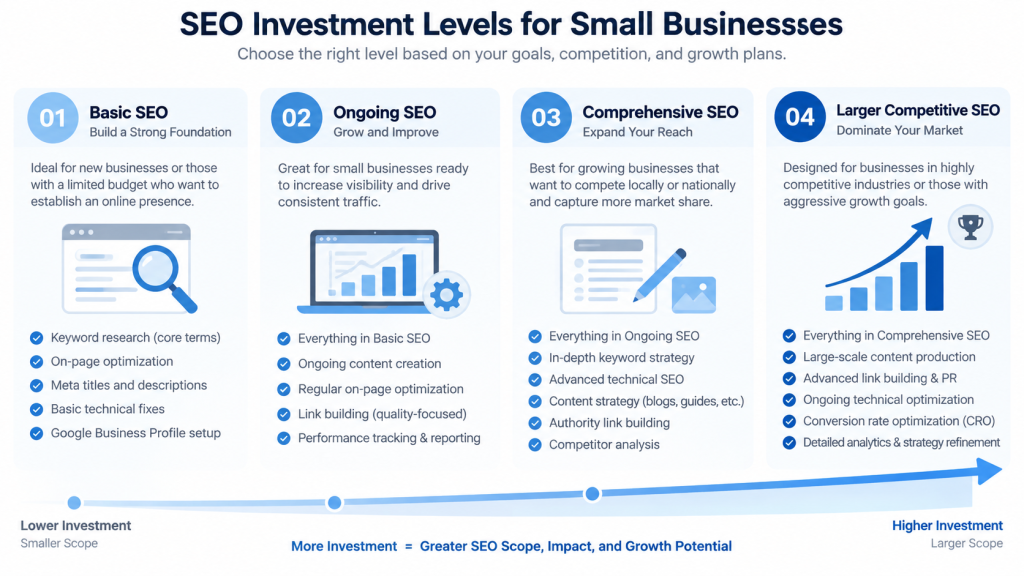
There is no standard SEO price because SEO isn’t a single service.
A small business might only need local SEO and on-page optimization, while an e-commerce business may need technical SEO, product page optimization, content creation, internal linking, and ongoing SEO monitoring.
As a general planning guide, small-business SEO may fall into these broad ranges:
| Monthly SEO Budget | What It May Cover |
|---|---|
| $300–$500 | Basic SEO guidance, keyword research, and limited on-page work |
| $500–$1,000 | Ongoing on-page optimization, keyword strategy, content recommendations, and reporting |
| $1,000–$2,500 | More comprehensive SEO, content, technical improvements, competitor research, and link-building activities |
| $2,500+ | Larger websites, competitive industries, e-commerce SEO, national campaigns, or extensive execution |
These aren’t fixed industry prices. They are useful budget ranges, and the actual cost should be based on the amount and complexity of work required.
For example, a local plumber targeting one city doesn’t necessarily need the same SEO budget as an e-commerce company competing nationally.
What Determines How Much You Should Spend on SEO?
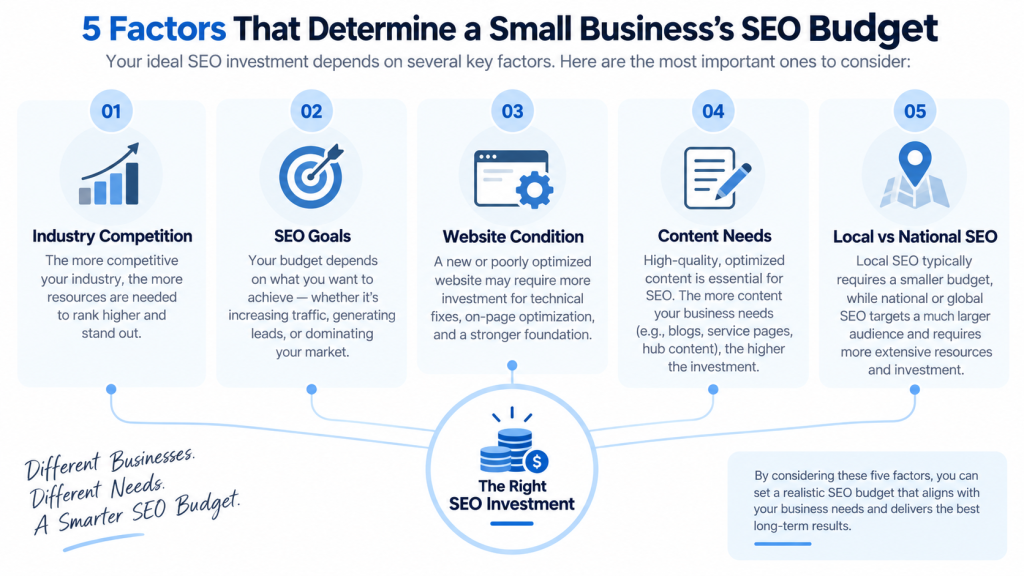
Several factors influence the right SEO budget for a small business.
1. Your Industry Competition
Competition is one of the biggest factors.
If you’re operating in a niche with relatively few competitors, it may take less work to gain visibility.
But if you’re competing for highly valuable keywords in industries such as legal services, real estate, finance, healthcare, or e-commerce, you’ll generally need a larger and more sustained SEO investment.
Before deciding on a budget, look at:
- Who currently ranks for your target keywords
- How established their websites are
- The quality of their content
- Their backlink profiles
- How many businesses you’re competing against
- Whether you’re targeting a local, regional, national, or international audience
A $500 SEO budget may be reasonable for one business and completely inadequate for another.
2. Your SEO Goals
Your budget should also depend on what you’re trying to accomplish.
For example, your goal might be to:
- Get more local customers
- Improve Google rankings
- Increase organic traffic
- Generate more leads
- Improve product visibility
- Increase online sales
- Build long-term organic visibility
A small local business may need a different strategy from an online store trying to rank across an entire country.
The clearer your goals are, the easier it becomes to determine what SEO work should be prioritized.
3. The Condition of Your Website
Your existing website also affects the amount of SEO work required.
A website with a strong technical foundation may need relatively straightforward optimization.
Another website may have:
- Slow pages
- Broken links
- Poor site structure
- Duplicate content
- Indexing problems
- Weak internal linking
- Poorly optimized product pages
- Missing or poorly written metadata
- Thin or outdated content
In that situation, part of the SEO budget may need to go toward fixing the website before focusing heavily on content or rankings.
This is why a good SEO process should start with an audit or assessment rather than immediately recommending a generic package.
4. How Much Content You Need
Content can be another major part of an SEO budget.
A small business might need only a handful of highly targeted articles each month.
A larger website may need a consistent content strategy covering:
- Informational keywords
- Commercial keywords
- Product-related searches
- Comparison searches
- Location-based searches
- Frequently asked questions
However, publishing more content doesn’t automatically mean better SEO.
Quality and search intent matter more than simply producing a large number of articles.
5. Whether You Need Local SEO or National SEO
Your geographic target can dramatically change the amount of competition you’re facing.
For example:
“SEO consultant in [city]”
is a much narrower search than:
“SEO services”
A local business may therefore be able to start with a more focused SEO strategy involving:
- Google Business Profile optimization
- Local keyword research
- Local landing pages
- Citation management
- Review strategy
- Local content
- Local link opportunities
National or international SEO campaigns generally require broader keyword targeting and more competition analysis.
Should You Hire a Freelancer or an SEO Agency?
Your budget can also determine which type of SEO provider makes sense.
Freelancer or Independent SEO Specialist
A freelancer can be a good option for a small business that doesn’t need a large team.
You may work directly with the person responsible for:
- Keyword research
- On-page SEO
- Technical SEO
- Content optimization
- Internal linking
- Reporting
This can provide a more focused approach without the overhead of a larger agency.
SEO Agency
An agency may make more sense if your business needs multiple specialists working on different areas of SEO.
For example, an agency may have separate people handling:
- SEO strategy
- Content
- Link building
- Technical SEO
- Development
- Reporting
The trade-off is that agency pricing can be higher.
The cheapest option isn’t necessarily the best option. What matters is whether the provider can clearly explain what they’re going to do, why they’re doing it, and how the work will be measured.
What Should Be Included in an SEO Package?
Before agreeing to an SEO price, ask exactly what you’re getting.
A legitimate SEO campaign may include some combination of:
SEO Audit
An initial review of your website to identify technical, content, on-page, and structural opportunities.
Keyword Research
Identifying the searches that are relevant to your products or services and have realistic ranking potential.
On-Page Optimization
Improving elements such as:
- Page titles
- Headings
- Meta descriptions
- Content
- URLs
- Internal links
- Image optimization
- Search intent alignment
Technical SEO
Depending on the website, this can include:
- Crawling and indexing issues
- Broken links
- Site architecture
- Core Web Vitals
- Duplicate content
- XML sitemaps
- Canonicalization
- Structured data
Content Optimization
Improving existing pages and identifying opportunities for new content.
Internal Linking
Creating logical connections between relevant pages so users and search engines can navigate the website more effectively.
Reporting
You should be able to see what work has been completed and how the website is performing over time.
How Much Should You Spend If You're Just Starting?
If you’re a small business that has never invested in SEO before, you don’t necessarily need to start with an expensive campaign.
A practical approach is to:
1. Establish Your Goals
Determine whether you want leads, sales, local visibility, traffic, or a combination.
2. Audit Your Existing Website
Find out what is already working and what needs improvement.
3. Identify Your Highest-Value Opportunities
Prioritize keywords, pages, and technical issues that could have the greatest business impact.
4. Set a Realistic Monthly Budget
Choose an amount you can maintain consistently rather than spending heavily for one month and stopping.
5. Measure Progress
Track organic clicks, impressions, rankings, conversions, and other meaningful business metrics.
SEO generally works as a longer-term investment. Trying to judge a campaign after only a few weeks can lead to unrealistic expectations.
Is Cheap SEO Worth It?
Sometimes a lower-cost SEO service can be appropriate if the scope is limited.
For example, a small business may only need:
- Keyword research
- Basic on-page optimization
- Local SEO guidance
- A technical SEO assessment
The problem occurs when a provider promises a comprehensive SEO campaign for a price that doesn’t realistically allow enough time or resources to do the work properly.
Be cautious of providers promising:
- Guaranteed #1 rankings
- Instant results
- Thousands of backlinks for a very low price
- Secret Google ranking methods
- Guaranteed traffic increases
- Extremely fast results
SEO involves variables that no legitimate provider can completely control.
A better SEO provider should be able to explain what they will do, what they can measure, and what results are realistically possible.
How to Choose the Right SEO Budget
Instead of asking:
“What’s the cheapest SEO package I can find?”
ask:
“What SEO work does my business actually need?”
A local business with one website and a small service area may need a relatively focused campaign.
An e-commerce business with hundreds of products may need substantially more work.
Likewise, a business competing in a highly competitive national market will likely need a larger investment than one targeting a small local market.
The right SEO budget is the one that gives your website enough resources to make meaningful improvements consistently over time.
Final Thoughts
So, how much should a small business spend on SEO?
There isn’t a universal number.
A small business may start with a few hundred dollars per month for focused SEO work, while a more competitive campaign may require $1,000, $2,500, or significantly more each month.
What matters most is matching your investment to:
- Your competition
- Your website’s current condition
- Your target audience
- Your SEO goals
- The amount of work required
- Your expected return on investment
Rather than choosing an SEO provider based solely on price, look for someone who can explain what needs to be improved, why it matters, and how success will be measured.
SEO should be treated as an investment in your website’s long-term visibility—not simply another monthly expense.
Frequently Asked Questions
How much does SEO cost for a small business?
Small-business SEO can range from a few hundred dollars per month to several thousand, depending on the provider, competition, website size, and scope of work.
Is $500 a month enough for SEO?
It can be enough for a focused SEO project or limited ongoing optimization, particularly for a small local business. However, the amount of work possible at that budget will be more limited than a comprehensive campaign.
Is SEO worth paying for as a small business?
SEO can be worthwhile when it targets searches that are relevant to your customers and business goals. The value depends on factors such as search demand, competition, conversion rates, and the value of the customers you acquire.
How long does SEO take to work?
SEO is generally a long-term process rather than an immediate marketing channel. The timeline varies depending on the website, competition, industry, and work being performed.
Should I hire an SEO freelancer or agency?
Either can be a good choice. A freelancer may be suitable when you want direct access to one SEO specialist and have a focused scope. An agency may be more appropriate when you need a broader team and multiple SEO services.
Ready to Invest in SEO?
Not sure how much SEO your business actually needs?
I can review your website, identify the biggest SEO opportunities, and help you prioritize the work based on your goals and budget.